
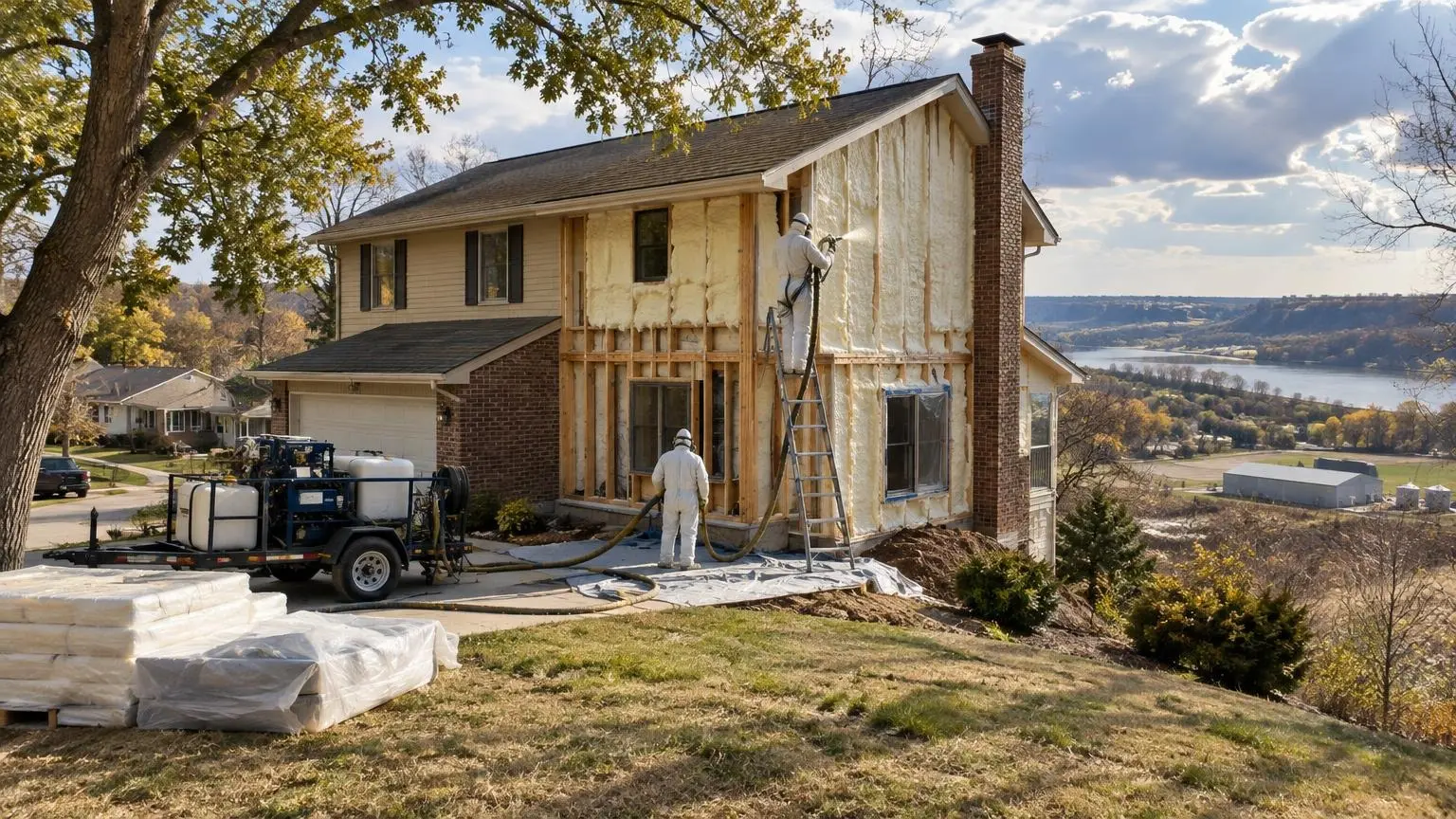
From midtown two-stories to West Omaha
Spray Foam Insulation in Omaha, NE
A city that spread west for fifty years has every kind of house, and every kind of leak.
- Free on-site estimates
- Written quote with material, inches and R-value per area
- Leaks, moisture and old wiring checked before anything is covered
Old Omaha, New Omaha
Spray Foam Insulation Omaha works across a city of 203,215 housing units, counted in the 2020 census, that was built in layers. The river wards and midtown hold houses from the late 1800s and early 1900s; the suburbs of the postwar years ring them; and since the 1970s most growth has gone west, where West Omaha is now home to most of the city's people. Each layer leaks in its own way, and we plan the insulation around which one your house belongs to.
Older neighborhoods
Two-story frame houses and brick homes near downtown and in midtown often have empty exterior walls, open stud bays running into the attic, and a basement rim joist with nothing on it. Dense-pack walls, attic sealing and closed-cell foam on the rim are the usual plan.
Postwar and 1970s houses
Ranches and split-levels have some attic insulation and usually not enough, plus leaky rim joists and cantilevered floors. A split-level's lower level often runs cold for that reason.
West Omaha subdivisions
Newer two-stories tend to be tighter, but bonus rooms over the garage and vaulted great rooms are common comfort complaints. Foam in kneewalls, garage ceilings and shallow vaults is the fix.
Weather on both ends
Omaha's climate is hot-summer humid continental. July humidity averages around 70%, the city hits 90F on about 29 days a year, and January lows average 15.2F at Eppley Airfield, with a record of -32F. Storms are part of the record too: the 1913 Easter Sunday tornado wrecked much of midtown, and a 1975 tornado and blizzard did more than $100 million in damage.
Get a free estimate or call (531) 217-5896 to book a visit anywhere in Omaha.
What to Know in Omaha
- Housing count. The 2020 census counted 203,215 housing units in Omaha, with growth since the 1970s going mostly to the west.
- Temperature range. Eppley Airfield normals show a 15.2F January low and an 88.1F July high, with records of -32F and 114F.
- OPPD weatherization rebate. OPPD lists $0.25 per sq ft for attic insulation (up to $500 contractor-installed) in homes built in 2004 or earlier, with a finished R-49 minimum.
- Energy code. Nebraska enforces the 2018 IECC statewide since July 1, 2020: R-49 ceilings, R-20 walls and a 3 ACH50 air leakage limit for new homes.
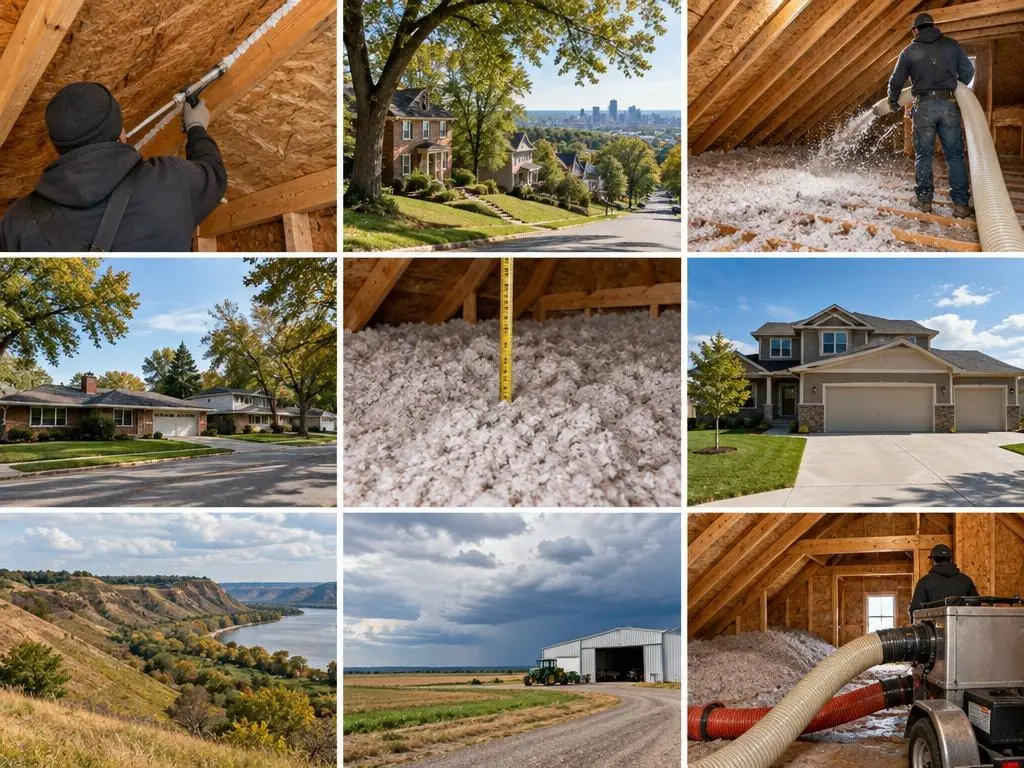
Omaha Questions
Is spray foam worth it for an older Omaha house?
In the right spots, yes: the rim joist, bonus rooms, shallow vaults and kneewalls. For empty plaster walls, dense-pack cellulose is usually the better value, and for an open attic floor, sealing plus blown-in is often enough.
Does OPPD have an insulation rebate?
OPPD lists a weatherization rebate of $0.25 per square foot for attic insulation, up to $500 when a contractor installs it, for homes built in 2004 or earlier. The attic has to reach at least R-49, and the application is due within 90 days.
How do I compare insulation companies in Omaha?
Ask each for a written quote that lists the material, inches and R-value for every area, how air sealing is handled and how long the house must stay empty after foam. Compare the scope line by line, not just the total.
Spray Foam Insulation Near Omaha
- Spray Foam Insulation in Council Bluffs, IA
- Spray Foam Insulation in Bellevue, NE
- Spray Foam Insulation in Papillion, NE
- Spray Foam Insulation in La Vista, NE
- Spray Foam Insulation in Ralston, NE
- Spray Foam Insulation in Elkhorn, NE
- Spray Foam Insulation in Gretna, NE
- Spray Foam Insulation in Valley, NE
- Spray Foam Insulation in Blair, NE
- Spray Foam Insulation in Fremont, NE
- Spray Foam Insulation in Plattsmouth, NE
- Spray Foam Insulation in Glenwood, IA
- Spray Foam Insulation in Carter Lake, IA