
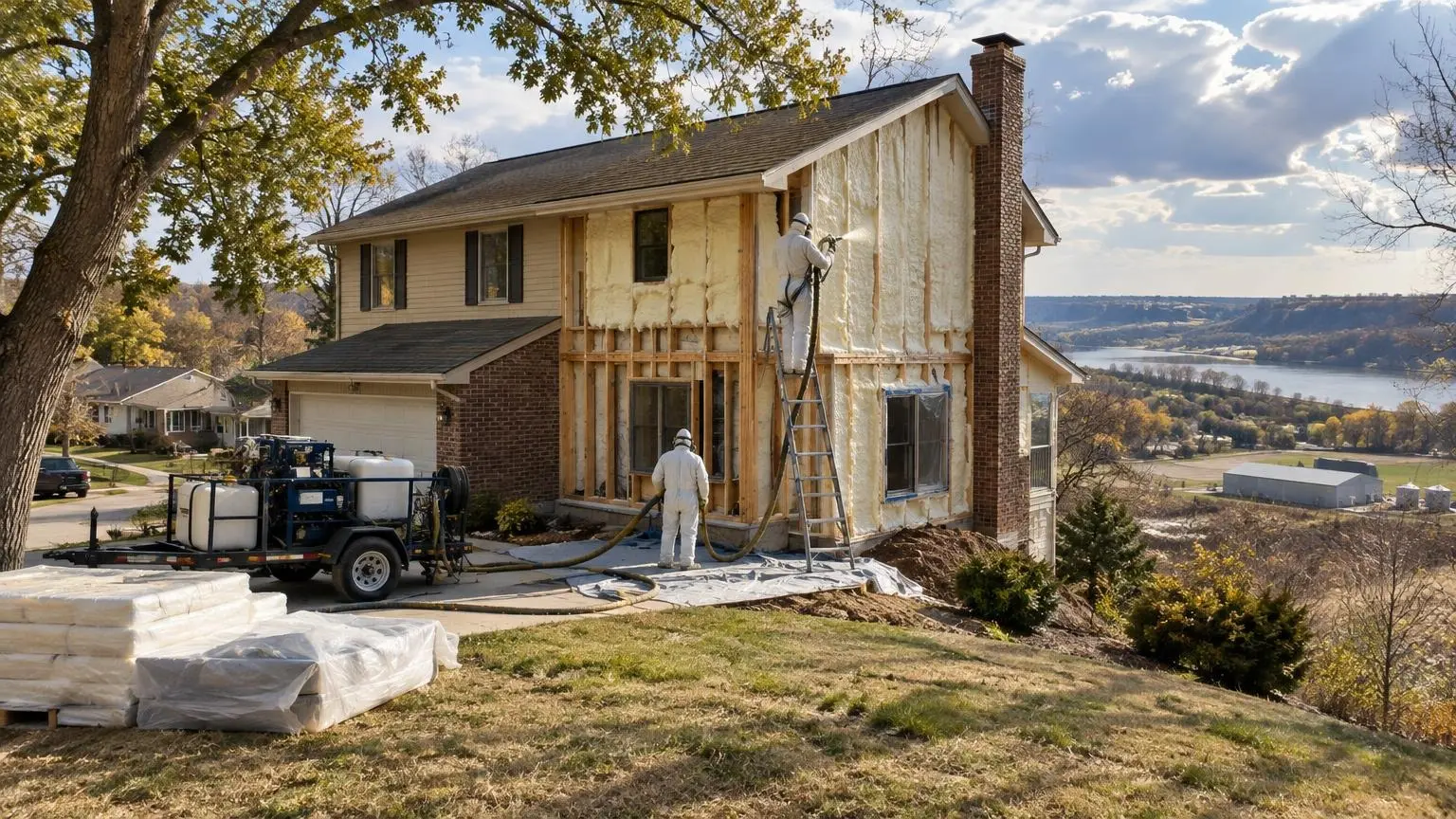
Closed cell, open cell, or a mix
Spray Foam Insulation in Omaha, NE
A single layer that stops moving air and adds R-value, sprayed only on the surfaces where it earns its price.
- Free on-site estimates
- Written quote with material, inches and R-value per area
- Leaks, moisture and old wiring checked before anything is covered
Foam That Fills the Gaps Batts Leave Behind
Spray foam insulation starts as two liquids that meet at the gun, expand on contact and set into a solid layer bonded to the framing. Because it grows into every crack and seam it touches, it insulates and air seals at the same time. That double duty matters in Omaha, where the Eppley Airfield record runs from -32F to 114F and a house spends months heating and months cooling. Batts and loose fill slow heat, but air slides right past them; foam closes the path.
Closed cell vs open cell
The two foams behave very differently, and most homes we quote use both.
Closed-cell foam is dense and hard once it cures. HomeGuide lists it at R-5 to R-7 per inch. At normal thickness it slows water vapor, stiffens what it is sprayed on and shrugs off occasional wetting. It is our default for rim joists, poured basement walls, crawl space walls, steel buildings and any surface that can sweat.
Open-cell foam is light and spongy, listed by HomeGuide at R-3.5 to R-3.7 per inch. It swells far more as it is sprayed, filling irregular rafter bays and wall cavities completely, and it costs less per square foot. It is common on the underside of roof decks and in interior walls where sound control matters. Because it lets vapor through, it is kept away from spots that can get wet.
Which foam has the highest R-value?
Per inch, closed cell wins comfortably, which is why it goes where space is tight: a 2x6 rim joist pocket or a basement wall that will be framed out. Open cell needs more thickness to match, but it is cheaper per inch and works where depth is not a problem.
Where it pays in this market
Nebraska's statewide code, the 2018 IECC in force since July 1, 2020, asks new homes in Climate Zone 5 for R-49 ceilings, R-20 walls (or R-13 plus R-5 continuous) and R-15 continuous or R-19 cavity on basement walls, and it caps air leakage at 3 air changes per hour on a blower door test. Iowa homes across the river in Council Bluffs fall under the 2012 IECC, which sets a 4 ACH limit in Zone 5. Older houses were never built to those numbers. Foam is the quickest way to bring the leakiest parts of an existing house, the rim joist, the bonus room and the cathedral ceiling, close to modern performance.
When foam is not the answer
For a wide-open attic floor, sealing the top plates and penetrations and then blowing loose fill to depth usually gives the same comfort for less money. We will tell you when that is the case. Foam also should not go over active roof leaks, wet framing or old knob-and-tube wiring; those get fixed or flagged first.
Get a free estimate or call (531) 217-5896 and we will come measure.
Where We Spray Foam
Spots in Omaha and Council Bluffs homes where foam usually beats any other material.
Rim joists and sill plates
Closed-cell foam around the full basement perimeter, where framing meets the foundation and cold air pours in.
Bonus rooms over garages
Foam on the garage ceiling below, the kneewalls and the sloped ceiling so the room tracks the thermostat.
Cathedral and vaulted ceilings
Rafter bays too shallow for batts filled with foam that seals and insulates in the same depth.
Unvented attics
Foam on the roof deck so ducts and equipment in the attic sit inside the conditioned space.
New homes and additions
Open stud and rafter bays sprayed before drywall to the R-values in the Nebraska or Iowa code.
Typical Spray Foam Insulation Costs
| Job | Range and source |
|---|---|
| Spray foam, installed | $1.50 to $5.00 per sq ft (HomeGuide) |
| Open-cell / closed-cell | $1.50 to $3.50 / $3.00 to $5.00 per sq ft (HomeGuide) |
| About 1,000 sq ft | $1,500 to $5,000 (HomeGuide); $3,150 to $7,500 existing home (Fixr) |
| Existing walls / new construction | $3.15 to $7.50 / $2.75 to $6.50 per sq ft (Fixr) |
| All exterior walls | $4,000 to $10,000 (HomeGuide) |
| Whole house | $8,000 to $20,000 (HomeGuide); $10,000 to $30,000 (Fixr) |
| Typical job minimum | $1,000 to $2,000+ (HomeGuide) |
National numbers from HomeGuide (2026) and Fixr (2025), not Omaha bids. The foam type, inches sprayed, how easy the space is to reach and any prep or removal move the total, and small jobs often land on a minimum charge. Your written estimate is what you actually pay.
How a Spray Foam Job Runs
1. Look and measure
We check each space for moisture, wiring and leaks and measure every surface to be sprayed.
2. Written quote
Each area is listed with foam type, inches, target R-value and price, plus any covering foam will need.
3. Prep and spray
Floors and belongings are covered, the area is closed off and ventilated, and foam goes on in passes.
4. Cure and walk-through
The house stays empty while the foam cures; then we trim, clean up and check the work with you.

Why Choose Us for Spray Foam Insulation
Inches in writing
The quote names thickness and R-value for each surface so the finished job can be checked.
The right foam per spot
Closed cell where moisture matters, open cell where fill and price matter more.
Spray Foam Insulation Questions
What does spray foam insulation do that fiberglass does not?
It stops air from moving as well as slowing heat. Fiberglass resists heat flow but lets air pass, so drafts and moisture still travel through it. Foam fills the gap and blocks the airflow in one layer.
How long do we need to be out of the house?
HomeGuide advises staying out for at least 24 hours after spraying, and longer if the product instructions require it. We ventilate during and after the work and tell you when it is ready.
Can you foam a finished wall?
Standard spray foam needs open cavities. For closed walls, dense-pack cellulose blown through small holes is usually the practical choice; our blown-in page explains how that works.
Does foam have to be covered?
In living space, basements and most storage areas, exposed foam generally needs a thermal or ignition barrier such as drywall or an approved coating. The quote marks where that applies.

Spray Foam Insulation Service Areas
- Spray Foam Insulation in Omaha, NE
- Spray Foam Insulation in Council Bluffs, IA
- Spray Foam Insulation in Bellevue, NE
- Spray Foam Insulation in Papillion, NE
- Spray Foam Insulation in La Vista, NE
- Spray Foam Insulation in Ralston, NE
- Spray Foam Insulation in Elkhorn, NE
- Spray Foam Insulation in Gretna, NE
- Spray Foam Insulation in Valley, NE
- Spray Foam Insulation in Blair, NE
- Spray Foam Insulation in Fremont, NE
- Spray Foam Insulation in Plattsmouth, NE
- Spray Foam Insulation in Glenwood, IA
- Spray Foam Insulation in Carter Lake, IA
Get a Spray Foam Insulation Estimate
Show us the cold rooms. We will measure and quote foam only where it makes sense.